
Growing up, every school year began with the same ritual: buying fabric for a new uniform.
Because convenience won every debate in our household, my mother always took the cloth to a tailor just down our street. The logic seemed sound—he was a five-minute walk away, a familiar face in the neighborhood, and always eager for business.
“When can we collect it?” my mother would ask, handing over the material two weeks before reopening day.
“Day before school reopens, definitely,” he’d reply cheerfully, chalk tucked behind his ear, barely glancing up from his measuring tape.
The day before school reopened, I’d walk over with high hopes.
“The pocket stitching is almost done. Tomorrow morning, before assembly. For sure.”
Tomorrow morning came. The shop was shuttered, or he was frantically working on three other shirts. That turned into “Give me two more days,” which stretched into “Just by this weekend.”
The consequence didn’t fall on him; it fell on me.
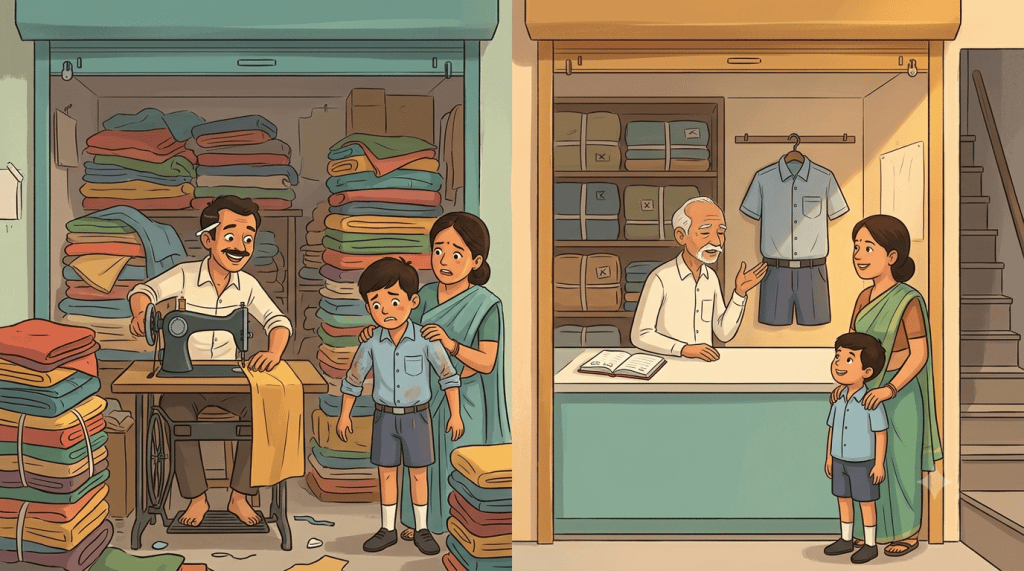
For the first two weeks of every school year, I was the kid standing out for all the wrong reasons. While my classmates showed up in crisp, sharp uniforms, I was squeezed into last year’s faded, tight shirt with the sleeves riding up to my forearms. Every morning assembly came with a knot in my stomach, waiting for the class teacher or the prefect to notice and demand an explanation. Explaining that “the tailor hasn’t stitched it yet” sounded like an excuse every single day.
The neighborhood tailor wasn’t malicious, and he wasn’t lazy. His counter was overflowing with piles of school fabric from half the children in our area. He took every order because turning someone away felt like a failure or losing a customer. So he said yes to everyone and banked on a miracle to pull it off.
After a couple of years of the same frustration, my mother decided we had had enough. We took the fabric to another tailor in town—further away, up a narrow staircase above the bus stand.
My mother handed him the cloth and asked if we could get it before day one.
The man looked at the fabric, glanced over his shoulder at the wall of marked cloth bundles, pulled out a small diary, and shook his head.
“Not possible before day one,” he said calmly. “The earliest I can deliver a clean stitch is the evening of the second day of school. If that works, leave the cloth. If you need it earlier, take it somewhere else—I won’t rush the work.”
I remember feeling a pang of disappointment. The nearby tailor had always promised it on time, even if he never delivered. This man was giving us bad news upfront.
We agreed.
On the evening of the second day of school, my mother and I climbed those stairs. The uniform was neatly ironed, pinned, and hanging behind the counter. The fit was exact. Not an hour late.
I spent one day in my old uniform, with zero anxiety, because I knew precisely when the new one would arrive. We never went back to the neighborhood tailor.
It took me years to realize how often that exact scene plays out in work and leadership.
In planning discussions, someone inevitably asks, “Can we hit the 15th?” The room nods. Everyone leaves feeling aligned, even though nobody has really checked the dependencies, factored in the unexpected bugs, or asked what other work needs to stop.
The agreement isn’t always real. Sometimes it’s just the absence of disagreement. Nobody wants to be the person who breaks the optimism in the room.
I’ve watched planning meetings change the moment a leader says, “I think the 15th should be achievable.” Nobody argues with the date anymore. The discussion quietly shifts from estimating the work to justifying the number. Silence gets mistaken for agreement, and hope gets mistaken for a plan.
The neighborhood tailor could always brush off a delay with a sheepish smile and a promise of tomorrow; he set his own pace. In a team, the dynamic is far more damaging. When an impossible date is locked in, people don’t just wait—they scramble. They stretch their hours, work through late nights, and exhaust themselves trying to rescue a commitment they never believed in. Status reports stay reassuringly green until the very end, hiding the strain. Over time, that kind of pressure doesn’t just miss deadlines; it burns people out until your best contributors quietly walk away.
Over time, I noticed something about the leaders whose projects rarely descended into that kind of panic. They didn’t rush people into promises. They let the team talk through the constraints before discussing dates. Someone would eventually ask what needed to be dropped to make the timeline work. Someone else would point out a dependency everyone had forgotten. The uncomfortable conversations happened early, while there was still time to do something about them.
More than that, they made it safe to speak up. Telling people to “be transparent” means little if the first person who raises a concern gets treated as difficult or uncooperative. People will only push back against a bad deadline when they know they are protected for doing so. As long as a concern is raised in good faith, it has to be welcomed—even if the risk never materializes. If you only protect people when their worst-case prediction comes true, they’ll stop warning you altogether.
And when someone eventually says, “I don’t think we can do that,” those leaders don’t treat it as resistance. They treat it as the most valuable piece of information in the room.
The first tailor told us what we wanted to hear. The second told us what he could actually do.
We never went back to the first one.
A “yes” carries weight only in a room where a “no” is allowed to breathe.

