
A baby elephant is tied to a post with a thin rope. It pulls and pulls, but the rope holds. After a while, it stops trying.
Years later, the elephant is strong enough to break the rope. But it doesn’t try. It has learned to believe that it can’t.
Teams can learn the same lesson.
Consider this illustrative story. A senior leader at a fast-growing data and AI company noticed that one of his teams wasn’t delivering as expected. The people were skilled, and the work was interesting. So he spent a week sitting with them, quietly watching how they worked.
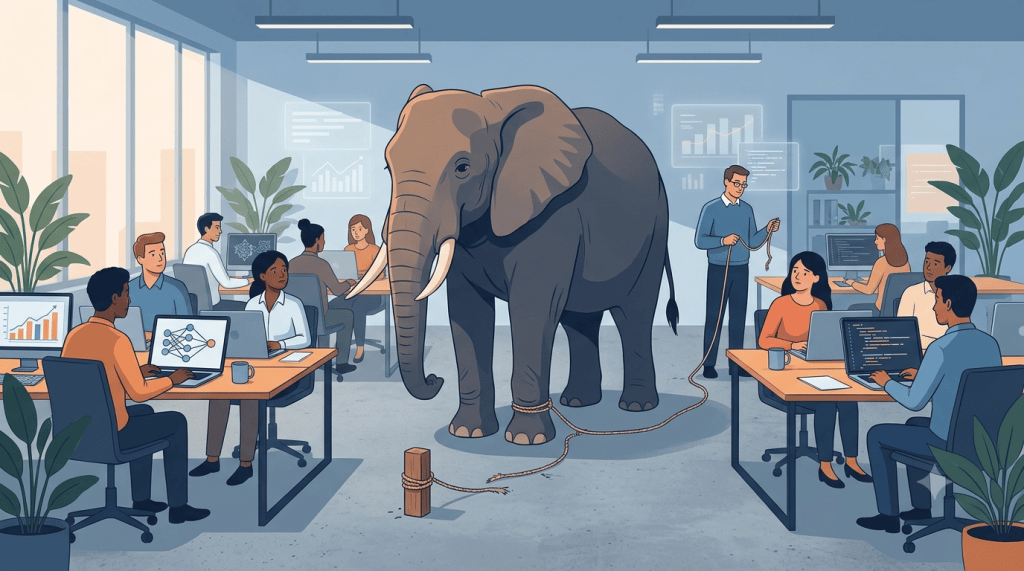
During the week, he noticed patterns that had likely been developing for months.
On Monday, everyone wrote a status update before opening a notebook. Then they spent forty-five minutes explaining what they had done. The manager asked for one more breakdown of the experiment logs.
On Tuesday, a data scientist suggested trying a smaller, easier-to-explain model. She asked for permission. The answer was, “Let’s stick with what we did last time.”
On Wednesday, the manager asked if anyone had ideas. Nobody spoke. The team had learned that sharing an idea didn’t always lead anywhere.
On Thursday, another “Any update?” message arrived. The model hadn’t changed. Each ping interrupted the focus needed to improve it.
On Friday, an email arrived late at night with detailed instructions to change a report’s font and move two columns. The model was still at version 0.3, but the formatting had to be perfect.
On the flight home, the leader wrote down what he had noticed:
- People asked, “Is this okay?” before taking small steps.
- Emails were long and defensive.
- Nobody brought new ideas.
- The most common answer was, “Whatever you think is best.”
- Nearly ten hours had gone into describing work instead of doing it.
Nobody was lazy. Everyone was busy. But the team had learned to stop trying.
Each time an idea was dismissed or work was unnecessarily rewritten, the team received the same message: don’t pull.
The leader wondered what the long-term cost of these habits might be. He didn’t have to wait long. The following Monday, one of the team’s strongest people resigned. In the exit interview, they said:
“I wasn’t leaving the company. I was leaving the control.”
That was when the leader understood. The team wasn’t weak. It had been trained not to act.
Micromanagement asks, “Are you busy?” Outcome-driven leadership asks, “Are we getting closer to the goal?”
One controls each step. The other explains what success looks like and lets people choose how to get there.
This matters especially in data and AI, where progress depends on experiments. Some experiments fail. But if people are afraid to fail, they may never try the idea that could work.
Research points to a similar link: a meta-analysis drawing on 319 studies and 151,134 participants found that job autonomy was associated with better job performance, mainly through stronger work motivation and less mental strain. Study summary
Signs Your Team Has Stopped Pulling
Look for patterns like these:
- People need approval for small, routine decisions.
- Team members ask, “Is this okay?” before acting.
- New ideas are rare, and people wait to be told what to do.
- Managers check in so often that people struggle to focus.
- Work is rewritten even when it already meets the standard.
- People spend hours reporting progress instead of making it.
- Decisions slow down because everything needs approval.
- Strong performers start to leave.
If you recognize several of these signs, it may be worth looking more closely.
Micromanagement often comes from anxiety, not bad intentions. A manager may fear failure, have been let down before, or feel pressure from above. Checking every detail can feel reassuring. But it can also teach a team to wait for permission.
The good news is that trust can be rebuilt, one small step at a time.
- Set the goal, then give people room. Explain what success looks like and when it is needed. Let the team choose the path.
- Use milestones instead of constant reports. Ask for updates at meaningful points, or when someone is blocked.
- Protect time for focused work. Fewer interruptions and shorter meetings give people more time to solve problems.
- Treat experiments as learning. A failed experiment can still show the team what to try next.
- Let good work stand. If the work meets the need, resist changing it just because you would have done it differently.
Before the plane landed, he asked himself one more question:
“Is there a rope in my own team?”
Ask yourself:
- Can my team make routine decisions without asking me?
- Do I describe the result I need, or prescribe every step?
- Would my team work differently if I weren’t watching?
- Do I measure progress by the work completed, or by the number of updates?
If your answers make you uncomfortable, take a closer look. Your team may have learned to stop pulling.
The rope may be weaker than it seems. Sometimes the first step is for the leader to let go.

