
I landed in Delhi few weeks back, running on minimal sleep. But the moment I stepped into the venue for Confluent Data Streaming World Tour, the fatigue vanished. The room was already packed—customers, partners, familiar faces, and new ones. It had that distinct buzz you only get when people genuinely want to be there, not just collect a badge.
Rubal Sahni, our VP of Sales for India & GCC, opened the session with a line that has stayed with me since:
“If you’re using a mobile phone, you’re actually touching our technology a few times a day.”
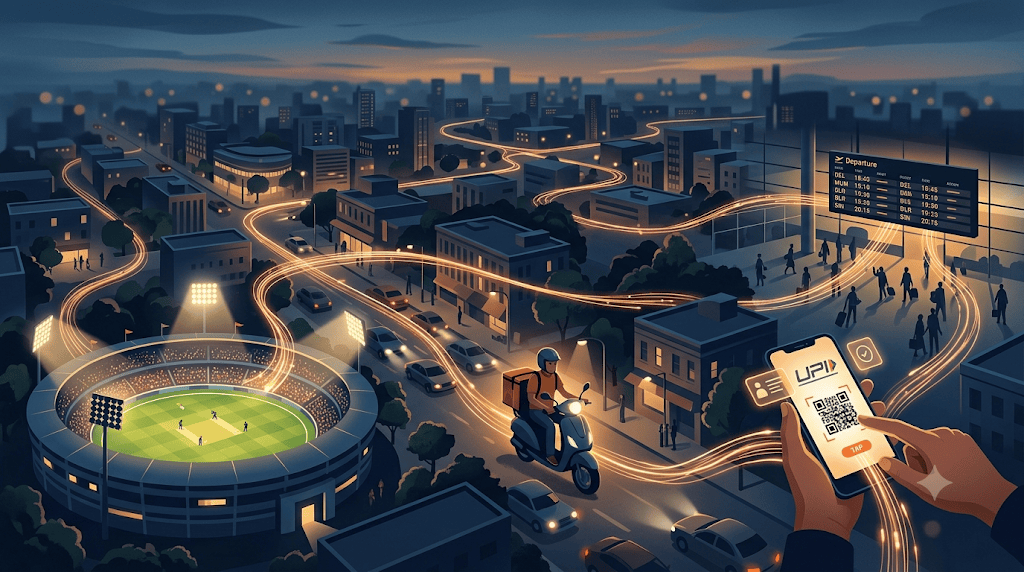
He paused, letting the silence do the work, then walked through the everyday rhythm of life. Watching the IPL. The Football World Cup. Booking a train ticket. Ordering dinner. Sending a quick UPI payment to a neighbourhood shop.
Around the hall, people started doing the quiet math in their heads—realizing just how many times their morning had quietly passed through our pipes before they even finished breakfast.
Sitting there, I caught myself doing the exact same math. And it took me back.
A few years ago, I was deep in the world of cloud infrastructure, managing virtual machines and architecture. I loved the craft. But explaining it at family gatherings was an exercise in watching eyes glaze over somewhere around the word “virtualisation, Public Cloud, Azure, AWS.” I would compromise, mumbling, “I manage computers on the internet,” met with that polite, sympathetic nod people give when they have completely lost the thread. It wasn’t that the work didn’t matter. It was just invisible—racks, uptime, compute cycles. Nothing you could touch or point to.
Listening to Rubal in Delhi, I realized what has fundamentally changed for me: I no longer have to simplify. I just have to point.
A cricket match where the boundary updates on your screen before the crowd stops cheering. A payment verified and recorded before your phone slips back into your pocket. A delivery driver arriving at your gate without a hitch.
None of this happens by luck. It happens because data no longer waits in cold storage to be processed in a late-night batch job. The instant something occurs, the information moves—carried on a live current, reaching everywhere downstream in the blink of an eye.
There’s an quiet satisfaction in that shift. When someone asks what I do now, I don’t talk about infrastructure. I talk about their evening, their commute, their dinner order. Watching their eyes light up with instant recognition—“Oh, so that’s what makes that work?”—never gets old.
Even with AI dominating every conversation today, this fundamental truth only becomes more critical. An AI agent is only as intelligent as the context it receives. It cannot reason on what happened yesterday; it needs to know what is unfolding right now, in the wild. The systems that lead won’t be the ones hoarding data in static repositories, but the ones moving it at the speed of human intent.
I flew back from Delhi thinking about the customer conversations from that afternoon. Hearing engineering leaders describe the complex, mission-critical problems they unlocked with real-time streaming wasn’t just another use case study. It was proof.
I am just one person among hundreds of engineers, architects, and teams building this fabric. But for the first time, when I look at the screen in my hand, I don’t need an analogy:
In a quiet, invisible way, you’re touching our work every single day—and we’re glad to keep it moving.
Note: The thoughts and opinions expressed in this post are my own and do not necessarily reflect the official views of my employer.

