
Last week I was at HiLite Mall in Thrissur with my family, headed into Lulu Hypermarket, when a sales executive from SBI Card stopped me near the entrance.
“Are you planning to take a credit card?”
“No,” I said. “I already have an HDFC and an ICICI card.”
She wasn’t ready to let go that easily. “But this one gives you cashback for every ₹100 you spend.” I still wasn’t convinced — I’ve heard that pitch a hundred times, and two cards in my wallet were plenty.
So I asked her a simple question: “I drive about 15,000 km a year. What’s in it for me, specifically?”
Here’s the thing — she knew the card inside out. Cashback percentage, the fact that it was tied specifically to BPCL fuel purchases, the reward structure, all of it. What she couldn’t do was the next step: take my number — 15,000 km a year — and turn it into a rupee figure that meant something to me. The feature was solid; the translation from feature to my life was missing.
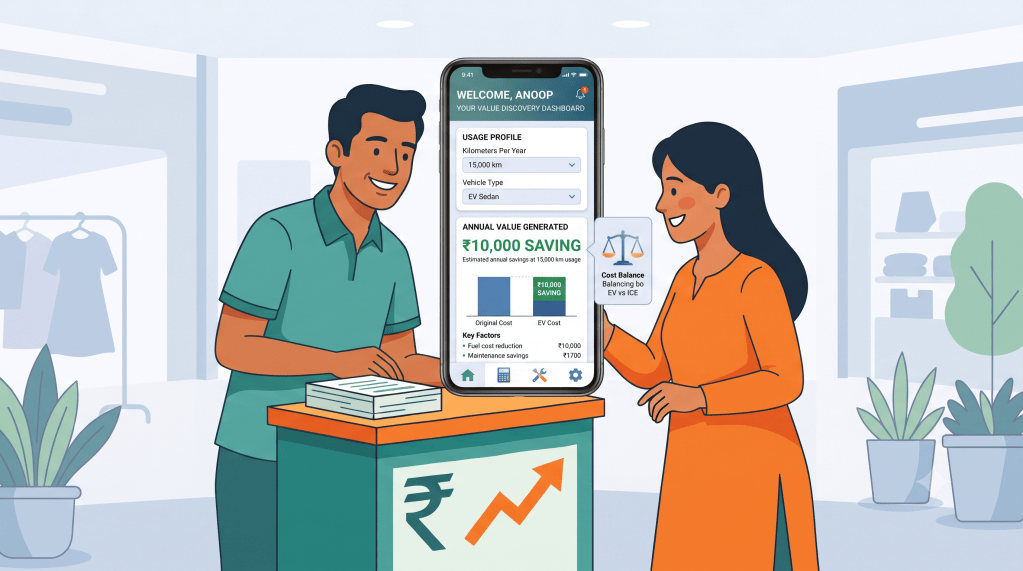
So I pulled out my phone, opened the calculator, and we worked it out together, right there at the kiosk.
- Average mileage of my car: 12 km per litre
- Annual distance driven: 15,000 km
- Fuel needed per year: 15,000 ÷ 12 = 1,250 litres
- Petrol price in Kerala that day: roughly ₹113 per litre
- Annual fuel spend: 1,250 × ₹113 = ₹1,41,250
- Card’s cashback/value-back on fuel spends: ~7%
- Annual benefit: 7% of ₹1,41,250 = close to ₹9,900
Watching that close to ₹10,000 emerge from my own driving habits — not a brochure example, not a generic “save more” line — was the moment the card went from “no thanks” to “actually, let me think about this.” I ended up applying for it right there at the kiosk.
While filling out the application, I told her something I couldn’t resist saying: “As a salesperson, don’t just ask the customer to buy the card. Show them the value it brings to their life. You knew this product better than I ever will — you just hadn’t connected it to my number yet.”
That moment stuck with me, because I realized we do exactly the same thing in the tech world, all the time.
Feature Selling vs. Value Selling
The SBI kiosk story is a perfect, tiny model of what happens in enterprise tech sales every single day — just with more zeroes and more slides.
As consultants, architects, and pre-sales engineers, we’re trained to be excellent at describing what our product does: the architecture diagram, the reference design, the throughput numbers, the list of connectors, the compliance certifications. We walk into a room and we are, frankly, brilliant kiosk representatives — we know our product cold.
But somewhere between the architecture diagram and the customer’s actual business, the thread gets lost. We stop before we get to the number that matters to them. We never do the “15,000 km a year” calculation. We assume the value is self-evident because the technology is impressive — and it usually isn’t self-evident at all.
Value selling flips the sequence. Instead of leading with the product and hoping the customer connects the dots, you start with the customer’s own metrics — their traffic, their transaction volume, their headcount cost, their churn rate, their infra spend — and you do the math with them, live, the way I did with my phone calculator at the mall.
The point isn’t to sell the product or the technology at all. The point is to sell what changes in the customer’s life or business once they have it — the crore saved, the fraud prevented, the hours their team gets back. The product is just the mechanism; the value is the story that actually matters to them.
Even Enterprise Architecture Agrees: Start From the Business, Not the Technology
This isn’t just a sales lesson — it’s baked into how good enterprise architecture is supposed to work. Look at TOGAF, the framework most large organizations use to plan their IT landscape. It doesn’t start with technology. It follows a deliberate top-to-bottom flow:
Vision → Business Architecture → Data Architecture → Application Architecture → Technology Architecture
You begin with the business vision and objectives — what is the organization actually trying to achieve? Only after that is clear do you move down into the business processes, then the data needed to support them, then the applications that handle that data, and finally the technology stack underneath it all. Technology sits at the bottom of that chain, not the top. It exists to serve the layers above it, not the other way around.
And yet, in most sales and pre-sales conversations, we do the exact opposite. We start at the bottom — “here’s our technology, here’s the architecture, here’s what it can do” — and hope the business value surfaces on its own somewhere in the conversation. TOGAF would tell us that’s backwards. If an enterprise architecture framework insists on starting from vision and business objectives before ever touching data, applications, or technology, shouldn’t our selling conversations follow the same discipline?
The “Calculator Moment” Is a Technique, Not an Accident
The most useful thing I did with the SBI sales executive wasn’t clever — it was just doing the arithmetic together, using my real numbers instead of generic marketing figures. But the number itself, ₹9,900, was never really the point. The point was what it represented: less friction every time I filled up, a small but real reduction in a cost I pay every single month without thinking about it. That’s a repeatable technique in tech selling too — and the discipline is to keep asking why the number matters, not stop once you’ve produced it:
- Ask for the customer’s actual numbers early: transaction volume, current latency, current infra cost, current time-to-insight, current headcount spent on manual reconciliation.
- Do the math live, in the meeting — a simple ROI calculation, a whiteboard sketch, a back-of-envelope estimate — rather than handing over a polished deck with someone else’s assumptions baked in.
- Don’t stop at the number. Ask how it changes things — are they becoming more efficient, faster, freeing up people to focus on higher-value work? The number is just evidence; the efficiency and speed behind it are the actual value the customer is buying.
- Let the customer see the number emerge from their inputs. It lands very differently when they’ve watched it get calculated, versus when they’re handed a conclusion.
The Real Takeaway
The SBI sales executive had a genuinely good product for me, and she knew it well. A fuel-linked cashback card, for someone who drives 15,000 km a year, is a strong fit. What was missing wasn’t product knowledge — it was the bridge from feature to my number. The moment we built that bridge together, on my phone’s calculator, I walked away with the card. Not because she convinced me — because I convinced myself, using my own numbers.
We do this constantly in tech. We have genuinely good products solving real problems. But if we stop at the architecture diagram and never pick up the calculator, we’re just a very sophisticated version of that mall kiosk: technically correct, and still not sold.
Value selling isn’t a soft skill bolted onto technical selling. It’s a discipline: don’t sell the product, don’t sell the technology — sell what it changes in the customer’s life and business. It’s the difference between a customer nodding politely and a customer pulling out their own phone to double-check your math — because now they’re invested in the number too.

