
Xavi Hernández… I am sure it is a familiar name to anyone who loves football. He was part of the iconic Spain team that won the World Cup back in 2010—the very same year I got married.
Throughout his career, Xavi played as a central midfielder. He wasn’t particularly fast, nor was he a flashy dribbler. Yet, he served Barcelona and the Spanish national team at the highest level for years.
So, what made Xavi so special?
The main role of a midfielder is to win the ball from the opponent and distribute it to teammates in attacking positions. But Xavi did this differently than everyone else. He did it through scanning.
In football, a “scan” is a quick head turn where a player looks away from the ball to take a snapshot of what’s happening around them.

While an average Premier League player scans 0.3 to 0.5 times per second (about 3 to 5 turns every 10 seconds), and elite midfielders like Luka Modrić scan around 0.6 times per second (6 turns), Xavi was in a league of his own at ~0.83 scans per second.
Over a 90-minute match, an average central midfielder scans the pitch roughly 200 to 300 times. Xavi was recorded scanning over 800 times per game.
He wasn’t waiting for the ball to come to his feet before looking up. He was turning his head every single second, even when the ball was on the complete opposite side of the field. He was constantly building a map of the pitch in his head.
What does this have to do with Technical Customer Success?
To me, technical success in a team is very similar to how Xavi played midfield. It’s all about continuously scanning the customer environment to pick up on subtle business and technical signals before issues arise.
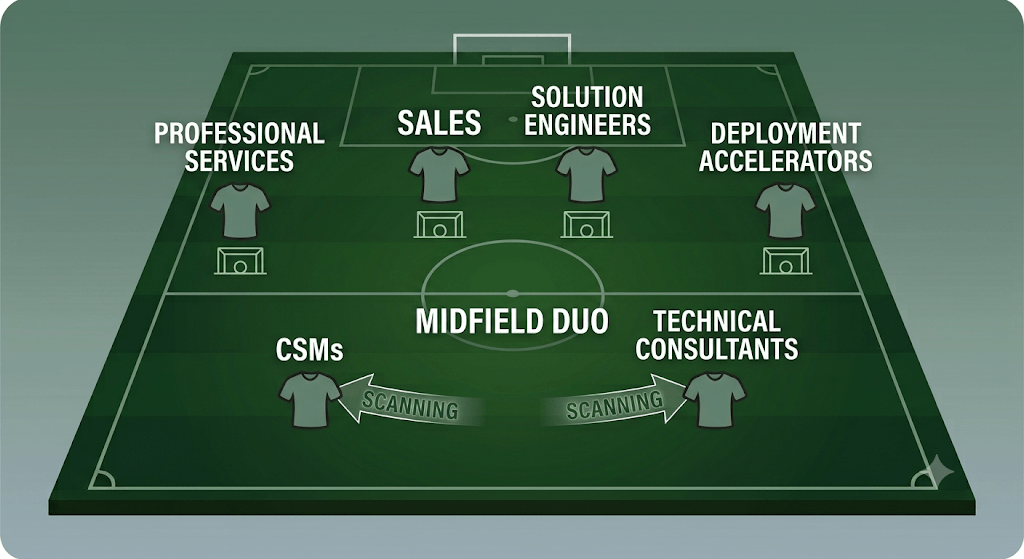
The post-sales technical team identifies these signals through day-to-day engagements like:
- Technical Consultation: Helping the customer truly understand the product and resolving technical issues quickly.
- Architecture & Best Practices: Guiding them on designing the right setup so things run smoothly.
- Product Adoption: Monitoring usage to ensure the customer is using the product to its full potential.
- Escalations: Catching complex technical issues early to manage or escalate them before they turn into major problems.
The Growth Mindset & Incentives
To truly excel at this, a Customer Technical Success professional must always operate with a growth mindset. Just like a great midfielder who is never satisfied with just standing still, a technical consultant should always be curious—looking for ways to help the customer learn more, adopt deeper, and scale bigger.
When you combine a growth mindset with the right incentives, this behavior is amplified. Aligning rewards with customer outcomes encourages the technical team to proactively look for those hidden opportunities rather than just waiting for issues to arrive.
The post-sales technical team acts as the pivot alongside the Customer Success team, who manages the overall relationship and commercial health. Both teams bring different perspectives.
By capturing these customer signals through regular technical engagements, they reduce risks and maximise business value—enabling other GTM teams like Sales, Solution Engineers, Professional Services, or Deployment Accelerator team to step in with the right solutions at the exact right moment.
Just like Xavi on the pitch, great technical consultants don’t just react when a problem drops at their feet—they are always looking ahead with a mindset to win.
As Xavi famously said:
“I spend the entire match looking for space. Always. I’m looking, looking, looking.”

