
For years, I had a very specific, high-stakes ritual every time I finished writing a blog post about Azure. But I was bit lazy to do proof reading few times to correct it and make a good flow.
So, like any loving husband, I did what felt natural: I handed it over to my wife.
Now, you have to understand—my wife works in a completely different domain. Cloud architecture to her might as well have been ancient Greek. But bless her heart, she never hesitated. She’d sit there for hours, squinting at complex technical terms, patiently fixing my clunky sentences, and trying to make my Azure ramblings actually read like human English.
Did those technical blogs make any sense to her? Absolutely not. But she was a total team player.
The silver lining for her back then? I rarely wrote blogs. So her “unpaid proofreading side-hustle” didn’t completely ruin her work-life balance.
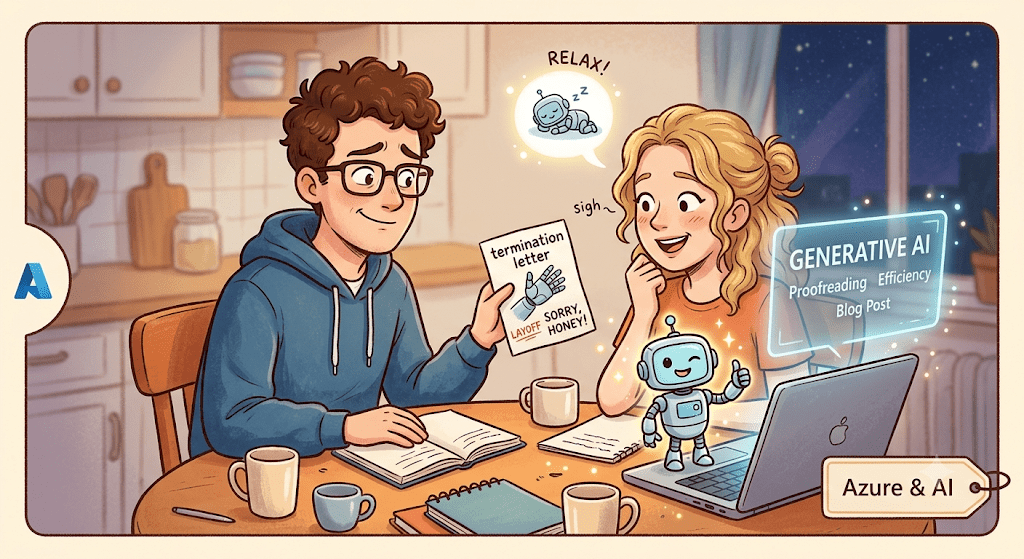
Generative AI: The Ultimate Corporate Layoff
Then came Generative AI.
Suddenly, I had a tool that could fix my grammar, polish my awkward flow, and give me suggestions in about three seconds flat. I didn’t need to beg, bargain, or offer coffee bribes anymore.
So, like a cold-hearted corporate manager, I laid my wife off from her proofreading role.
No exit interview. No severance package. Just a swift, merciless termination.
To be honest, she was probably thrilled with the news.
The Need for Speed (and Survival)
Trading my wife’s manual reviews for Gen AI completely changed my blogging routine. These days, as long as I don’t have to do deep, mind-bending research on a brand-new Azure feature, I can draft, polish, and publish an entire post in under an hour.
And honestly? If you work in tech today, avoiding AI feels almost impossible.
The tech world moves at breakneck speed now. Companies want everything done yesterday, and AI has become the secret weapon everyone uses to keep up:
- Instant Drafts: People dump a chaotic mess of bullet points into a prompt, and boom—a solid starting structure appears.
- Deck Magic: Turning boring, scattered notes into slick presentation slides in minutes.
- Quick Summaries: Turning 20-page reports into three crisp paragraphs before a morning meeting.
It’s all about efficiency. It lets us skip the painful staring-at-a-blank-page phase and jump straight to tweaking the final product.
The “Fancy Language” Trap
There is one funny twist to all of this, though.
Have you noticed that people’s expectations for language have shifted? Sometimes, if you write a presentation or an email using your normal, plain everyday words, it feels like people look at it funny. We’ve all gotten so used to the fancy, hyper-polished language generated by AI that standard human writing almost feels… too simple!
It’s a strange new world. We dump raw thoughts into a box, write a clever prompt, get a fancy foundation, and polish it up. It saves us time, keeps us productive, and—most importantly—keeps our loved ones from having to read technical jargon they never asked to see.
Are you using AI to speed up your daily work, or are you still doing things the old-school way? And more importantly… has AI saved your partner from reading your work documents yet? Let me know in the comments

