
A few days ago, I fell down an astronomical rabbit hole.
Right now, as you read this, Voyager 1 is drifting through the cold, dark silence of interstellar space, more than 24 billion kilometers away from Earth. If NASA engineers want to send it a simple “Hey, run a diagnostic check,” they have to beam a radio signal at the speed of light—roughly 300,000 kilometers per second, the absolute speed limit of the universe.
Even at that breakneck speed, it takes over 22 hours for the message to reach the probe, and just as long to get an answer back. That’s nearly two full days just to get a single checkmark on a screen. Imagine sending a message on Monday morning and waiting until Wednesday breakfast just to see the double blue ticks.
For thousands of years, our ancestors looked up at the night sky in awe. Whenever life got overwhelming—a failed harvest, a looming storm—they looked toward the clouds with an unshakeable belief that an ultimate power was listening. Today, we don’t just stare at the stars; we fling machines into deep space to talk to them.
Which got me thinking: if God lives somewhere out there in “Heaven”—presumably way past Pluto, past Voyager 1, past the Oort Cloud, and somewhere beyond the observable universe—how long is the lag on our prayers?
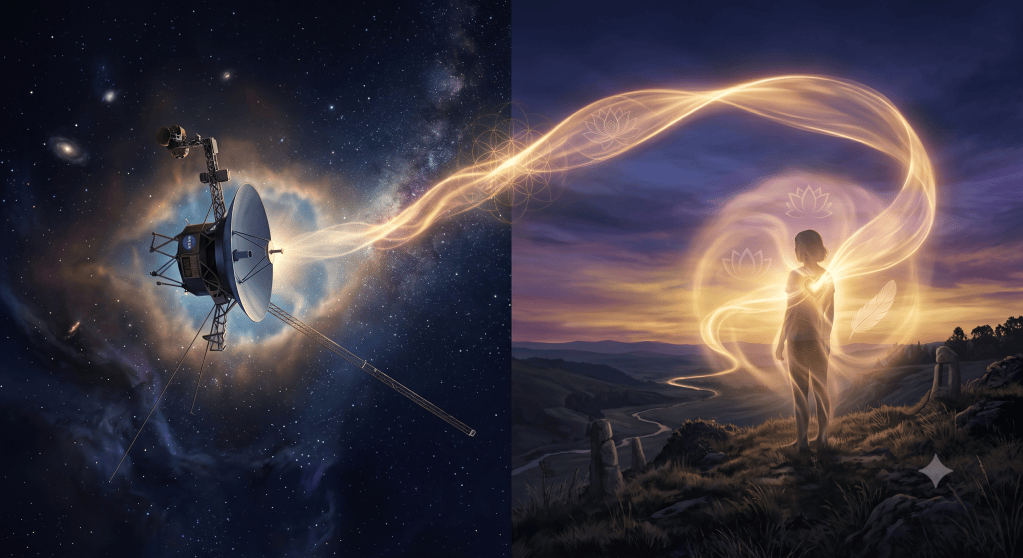
The Cosmic Network Latency
If we treat prayer like a standard electromagnetic transmission, we have a serious network problem.
Pinging the Moon takes about 1.3 seconds—decent home Wi-Fi speed. Pinging Mars takes up to 22 minutes, mildly annoying but survivable; you can grab a coffee and come back. Pinging Voyager 1 takes nearly a full day, which is where most of our patience runs out. But pinging the edge of the observable universe? That signal is traveling for over 46 billion years. For context, the universe itself is only about 13.8 billion years old. Your prayer wouldn’t just be late—it would outlive the sun, outlive the Earth, and still be cruising through the void long after every star currently visible in the night sky has burned out.
If God is sitting on a golden throne parked somewhere just beyond the last galaxy, that means if you pray for help on your Friday morning exam, your signal won’t even clear the local star cluster by the time your grandchildren are retired—and it still won’t have arrived by the time their grandchildren are stardust.
Talk about packet loss.
The “God Is Everywhere” Paradox
Of course, any believer or philosopher will immediately jump in and say: “You’ve got it all wrong. God doesn’t live on a distant planet. God is omnipresent—everywhere at once!”
It sounds comforting at first. If God is right here in the room, the travel time is zero milliseconds. No latency, no buffering, instant delivery.
But if you stop and think about it, that raises an even funnier dilemma. If God is literally everywhere—in the air, in the walls, in the chair you’re sitting on, in the atoms of your own brain—why do we close our eyes, look up at the ceiling, and shout our wishes at the sky like we’re desperately trying to catch a single bar of cell signal on a remote rooftop?
If God is everywhere, God was already there when you burnt the toast, when you made that questionable financial decision last week, and when you rehearsed an imaginary argument in the shower. You aren’t beaming a signal across the cosmos. You’re whispering to someone sitting right beside you, who somehow also already knows what you’re about to say.
So which is it? Is God a distant server, so far away that our prayers are still in transit from a decade ago? Or is God the Wi-Fi router in the room, already connected, already listening, and we’re the ones still holding up an antenna to an empty sky, out of habit more than necessity?
The Signal Was Never Leaving Earth
Maybe both answers miss the point. Maybe prayer was never really about reaching someone else at all.
Prayer is for us.
It is the intentional, quiet act of clearing the daily static and speaking directly to our own intent. It is looking inward in a noisy world and reminding ourselves: What do I actually care about? What do I need to fix? What kind of human being do I want to be today? What am I striving to achieve?
When we close our eyes and repeat our hopes, we aren’t uploading a cosmic wishlist into the cloud. We are programming our own minds. We are repeating our deepest intentions with such clarity that our everyday actions, choices, and habits finally start lining up behind them.
Next time you close your eyes, don’t worry about cosmic distances, data blackouts, or light-speed delays. You don’t need NASA’s Deep Space Network dishes, and you don’t need to aim at the stars.
The signal doesn’t have 24 billion kilometers to travel. The receiver was sitting inside you the entire time.

